The world of software quality and testing is changing faster than ever. AI is moving from the experimental stage to everyday practice. ISTQB is revamping its certifications. And in the job market for testers, the opposite of what many predicted is happening.
In this blog, we’ve compiled five current insights, each from a different perspective: strategy, organization, knowledge, tools, and people. Together, they serve as a guide for anyone responsible for software quality. For each insight, you’ll find a link to a detailed article in which we explore the topic in greater depth.
In this blog:
- AI in the Quality Process: From Experiment to Scale
- The Test Center: Build In-House or Outsource?
- ISTQB Redefines AI Testing
- Low-code and open source: the rise of Playwright
- Why the Demand for Testers Is on the Rise
1. AI in the Quality Process: From Experiment to Scale
Today, nearly every organization is experimenting with AI in its quality process. According to the World Quality Report 2025, 89% of companies are either conducting a pilot or already using generative AI in their workflows. Only 15% have succeeded in rolling out that application across the entire organization.
That gap speaks volumes. Installing a smart tool is the easy part. Scaling requires good data, clear agreements on governance, and a quality process that’s already in place. If you apply AI to a messy testing process, you’re mainly just automating the mess.
That’s why a successful AI approach starts with an honest baseline assessment. A Quality Assessment identifies where your process stands today, where AI truly adds value, and which prerequisites must be in place first.
Learn more about the benefits of Quality Assessments
2. The test center: Build it in-house or outsource it?
Barely 3 out of 10 companies have a test center that’s truly effective. Organizations that do it right see up to 73% fewer incidents in production. The difference between the two groups rarely lies in the tools, but rather in structure, expertise, and consistency.
Building an in-house testing center takes time. You need to recruit staff, develop methodologies, and retain knowledge—even when people leave. An external testing center provides that structure right away: experienced testers, proven processes, and capacity that scales with your projects.
For many organizations, this is the fastest way to achieve consistent quality without the fixed costs of maintaining an in-house team. The question isn’t whether you need a test center, but which model best suits your growth.
Discover the benefits of an off-site testing center
3. ISTQB Redefines AI Testing
In April 2026, ISTQB launched version 2.0 of the Certified Tester AI Testing (CT-AI) certification. It replaces the 2021 version, which predated the breakthrough of ChatGPT and other language models.
The most significant change: ISTQB has split the topic into two parts.
- CT-AI v2.0 is entirely focused on testing AI systems: data, machine learning models, and generative AI.
- CT-GenAI focuses on testing with AI: prompting, risks such as hallucinations, and AI-driven testing tools.
For teams, this means making a conscious choice. Are you testing software that incorporates AI, or do you want to use AI to test faster and more intelligently? Often, both are necessary. In addition, the old CT-AI v1.0 is being phased out: the English-language version will remain available until April 21, 2027.
What does the new ISTQB certification mean for your team?
4. Low-code and Open Source: The Rise of Playwright
In early 2022, Playwright was downloaded about 1.2 million times per week. By 2026, that number had risen to about 52 million downloads per week, according to figures from TestDino. This puts Microsoft’s open-source framework far ahead of established names like Selenium and Cypress.
There’s a reason for that growth. Playwright tests across Chromium, Firefox, and WebKit all at once, and with its built-in recorder, you can generate test scripts without having to write any code yourself. This makes test automation accessible to teams that don’t have extensive development resources.
Still, a popular tool isn’t necessarily a strategy. The real question is which tool is the right fit for your applications, your team, and your maintenance capacity. A low-code solution that gets off to a quick start can end up being costly after a year if no one maintains the test suite.
Read how a single tool is gradually taking over test automation
5. Why the demand for testers is on the rise
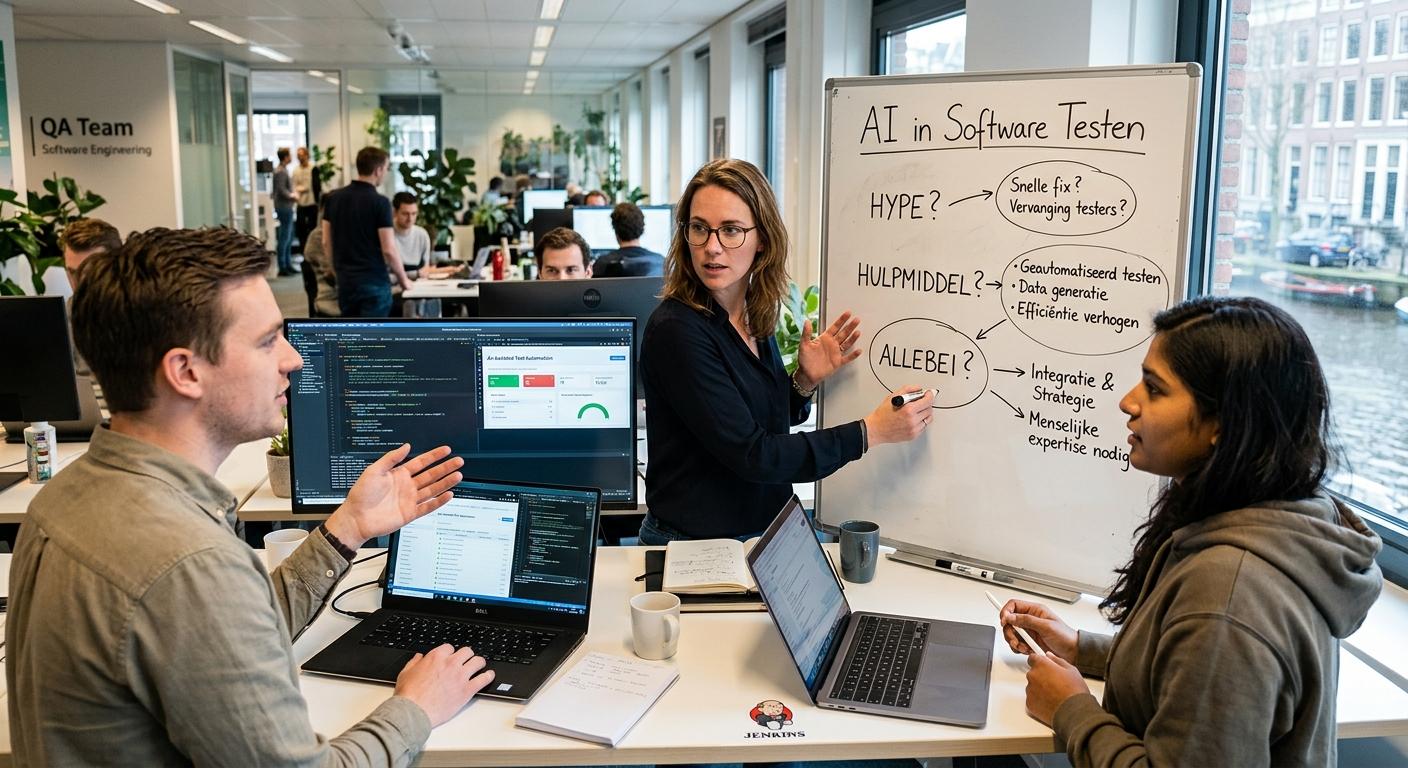
If you read the headlines, you’d think that AI is making software testers obsolete. In reality, the opposite is true: the demand for experienced testers is growing faster than ever.
The logic is simple. AI helps developers write code faster, so more software is being created at a faster pace. Every line of code—including that written by an AI assistant—must be reviewed. And AI systems themselves introduce new risks that require human insight: unpredictable behavior, biases in data, and new regulations such as the European AI Act.
This makes it more difficult for organizations to find the right candidates on their own. Hiring an experienced testing consultant gives you immediate access to specialized expertise, for the exact duration of your project.
Find out why the demand for testers is growing faster than ever
The common thread: Quality is still a human endeavor, supported by smart technology
Five perspectives, one conclusion. Technology is advancing rapidly, but quality only emerges when strategy, organization, knowledge, tools, and people are aligned.
| Perspective |
Key Question for Your Organization |
| Strategy |
Is our quality process ready to scale up AI? |
| Organization |
Should we set up a test center ourselves, or outsource it? |
| Knowledge |
Are our testers trained to test both AI and with AI? |
| Tooling |
Do we choose tools based on our needs, or based on the hype? |
| People |
Do we have the right test profiles on board at the right time? |
Those who have a clear answer to each of these questions can deliver software faster and with fewer errors in production. Those who skip even one usually don’t realize it until things go wrong.
How M2Q Can Help You
M2Q supports organizations in each of these five areas: from a Quality Assessment and an external test center to ISTQB training, low-code test automation, and experienced test consultants. Would you like to know where your quality process stands today? Contact us at info@m2q.be for a no-obligation consultation.
Frequently Asked Questions
Will AI replace the software tester?
No. AI takes over repetitive tasks, but more software is being developed that needs to be tested. Moreover, AI systems themselves require human oversight and critical testing.
What is the difference between ISTQB CT-AI and CT-GenAI?
CT-AI v2.0 teaches you how to test AI systems. CT-GenAI teaches you how to use generative AI to test software. Both require the Foundation Level (CTFL) as a prerequisite.
Is Playwright a low-code tool?
Playwright is at its core a code framework, but with the built-in recorder (Codegen), you generate test scripts by recording your actions. This lowers the barrier for teams with limited programming experience.
When should you choose an external testing center?
When you need structure and capacity quickly, without first having to build a full in-house team. It’s also a logical choice during project peaks or when there’s a shortage of specialized talent.