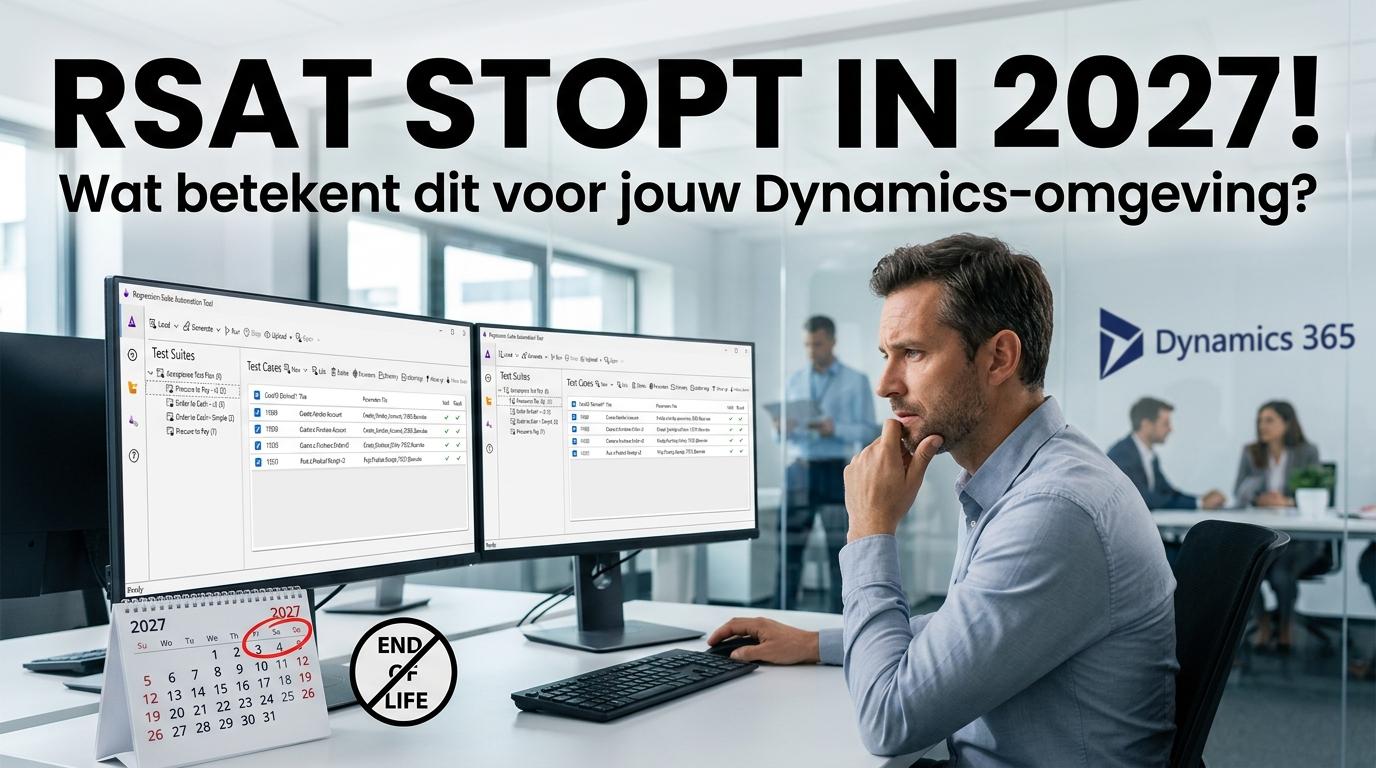
Anyone following developments in test automation within Dynamics 365 Finance & Supply Chain Management has received a clear message from Microsoft in recent months: RSAT, the Regression Suite Automation Tool, is being phased out. As of May 15, 2027, Microsoft will no longer provide support, bug fixes, or updates for the tool that for years was the standard way to automate regression testing within D365 F&SCM without writing a single line of code.
A year and a half sounds like plenty of time—and it is, provided you start now. Those who wait until early 2027 often don’t realize until then just how time-consuming migrating hundreds of test cases actually is. In this article, we outline exactly what’s changing, why Microsoft is taking this step, and what options D365 teams already have today to future-proof their test automation.
RSAT, the Regression Suite Automation Tool, is the free test automation tool that Microsoft itself provides with Dynamics 365 Finance & Supply Chain Management and Dynamics 365 Commerce. Functional testers and business power users use Task Recorder to record a business process, and RSAT converts that recording into a reusable, automated regression test—without requiring any programming knowledge. Test parameters are decoupled from the test steps and managed via Excel files, and execution and reporting are handled through an integration with Azure DevOps.
In practice, RSAT is primarily used to validate the biweekly to monthly “One Version” updates that Microsoft itself continuously rolls out for D365 F&SCM. After all, each update can affect existing functionality, and for many organizations, RSAT was the first, easy-to-use way to verify this without having to free up developer resources every time.
Microsoft confirms in its official documentation that RSAT has been marked for deprecation and will no longer be supported after May 15, 2027, with no replacement Microsoft tool being offered. This deadline is listed both on the RSAT overview page and on the official list of removed and deprecated features within Dynamics 365 Finance and Operations.
Microsoft does not explain the decision in detail, but anyone who follows the D365 community will immediately recognize the underlying reason. RSAT tests are built on recordings of the user interface, and any UI change in a D365 update can break such a recording. Furthermore, the initial setup of a test library is cumbersome, maintenance requirements grow with every expansion, and the tool remains limited to Finance & Operations apps, with no integration into the rest of the Dynamics 365 or Power Platform landscape. RSAT does not support self-healing automation or context awareness, which are key areas of focus in today’s test automation market.
Important to remember: the testing process itself isn’t going away. Every D365 update must continue to be validated. The only thing that’s being phased out is the tool that many organizations currently use to do that.
For teams currently running on RSAT, nothing will change in terms of functionality in the short term. The tool will continue to function as usual until May 15, 2027. The risk lies in what happens after that: a test library—sometimes built up over years—containing hundreds of test cases and valuable business logic, risks becoming unusable bit by bit as D365 updates continue to break the included tests, without any further tool updates to address the issue.
Moreover, those with a large test library often underestimate how much time a migration actually takes. Test cases must be rebuilt or migrated, new processes must be set up, and teams must get used to a different way of working. This isn’t a week’s worth of work, and organizations that wait until shortly before the deadline to tackle it put themselves under unnecessary pressure—exactly the pattern that M2Q has frequently warned against in previous research and publications: testing that becomes an afterthought rather than a process planned well in advance.
Since the announcement, a clear market has emerged consisting of vendors that specifically position themselves as RSAT replacements, each with its own approach. Some offer pre-built test libraries for the most important Dynamics 365 modules, others focus on automatically importing and converting existing RSAT and Task Recorder recordings, and still others are fully committed to AI-powered, self-healing test automation that handles UI changes better than a traditional recording.
What these providers generally have in common is that they are purely software-based solutions. They solve the technical problem but largely overlook the human aspect—namely, testers and QA teams learning to work independently and efficiently with a new tool. And that’s exactly where a migration process often gets stuck: migrating a tool is one thing; getting a team to the point where they can work with it independently is quite another.
At M2Q, we’ve been approaching test automation the same way for some time now, regardless of the platform: a low-code testing tool gives testers, business analysts, and QA professionals the ability to build robust, maintainable tests themselves using a visual interface, without having to code or rely on scarce developer resources. That same approach applies to a migration away from RSAT: it’s not just about replacing a tool, but about equipping a team to work with it independently.
M2Q had already proven that this approach works at Mediafin, the publisher of De Tijd, L’Echo, Sabato, Belegger, and L’Investisseur. There, regression testing for five platforms was initially done entirely manually, and a single full test cycle took a week—just not fast enough for the biweekly sprints. M2Q automated the entire regression test suite—about 150 test cases—using a low-code testing tool. Result: a test round that previously took a week was reduced to 6 hours—an 85% time savings—without compromising test coverage, and has since been running automatically several times a week.
Specifically for Dynamics 365 environments, M2Q also partners with ifacto on QA for ERP migrations, with the aim of guiding organizations that use MSD 365 through precisely these types of projects: from test strategy to the actual transition to sustainable, maintainable test automation.
Organizations that take a structured approach to transitioning from RSAT typically follow this path:
What is RSAT?
RSAT, the Regression Suite Automation Tool, is the free test automation tool that Microsoft provides with Dynamics 365 Finance & Supply Chain Management and Commerce. Functional testers record business processes using Task Recorder, after which RSAT converts those recordings into automated regression tests—without requiring any programming knowledge.
When exactly will Microsoft discontinue RSAT?
Microsoft will no longer support RSAT after May 15, 2027. The tool will continue to work as usual until that date, but after that, there will be no support, bug fixes, or updates.
What will happen to my existing RSAT test cases?
They remain usable as long as the underlying D365 interface does not change, but the risk increases as successive D365 updates cause the included tests to fail, without a Microsoft update being released to fix the issue.
Should I take action right now?
Yes, especially if you have a large test library. Migrating hundreds of test cases can take months, and if you wait until just before the deadline, you’ll often run out of time.
What are the alternatives to RSAT?
There is a growing range of specialized tools that import recordings, offer pre-built test libraries, or focus on AI-powered, self-healing test automation. In addition, just as with other platforms, you can opt for a low-code testing tool combined with the right training for your team.
Will M2Q help with the transition from RSAT to a new testing approach?
Yes. M2Q offers low-code test automation, licenses, and training, and works specifically with ifacto on Dynamics 365 to provide QA for ERP migrations, from test strategy to actual implementation.
The discontinuation of RSAT is no cause for panic, but it is a clear signal to start planning now rather than waiting until 2027. Organizations that start early can approach the transition calmly and in phases; those who wait risk facing the same time pressure that M2Q consistently observes in other testing processes: too little time for too much work, just when it’s least convenient.
Would you like to know the best way to manage your RSAT test library and how to empower your team to adopt a new, sustainable testing approach for Dynamics 365? Contact M2Q, or learn more through our partnership with ifacto about how we specifically approach QA in MSD 365 projects.