Many Flemish and Belgian companies are currently facing the same obstacle: a pressing shortage of experienced software testers and specialized QA capacity. How can you handle spikes in workload without tying yourself down to expensive, long-term hires? And how do you ensure that internal domain knowledge is seamlessly integrated with external testing expertise?
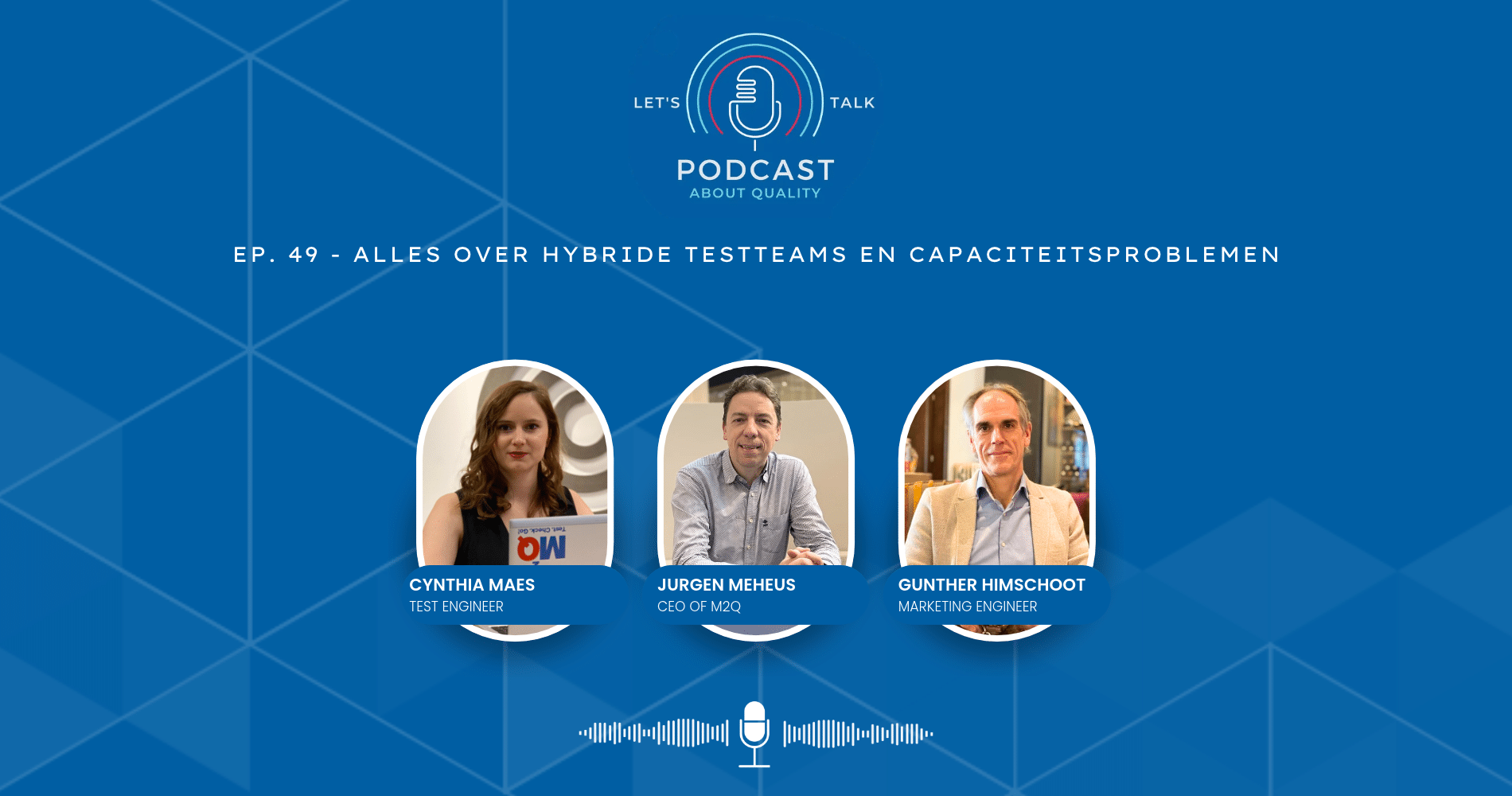
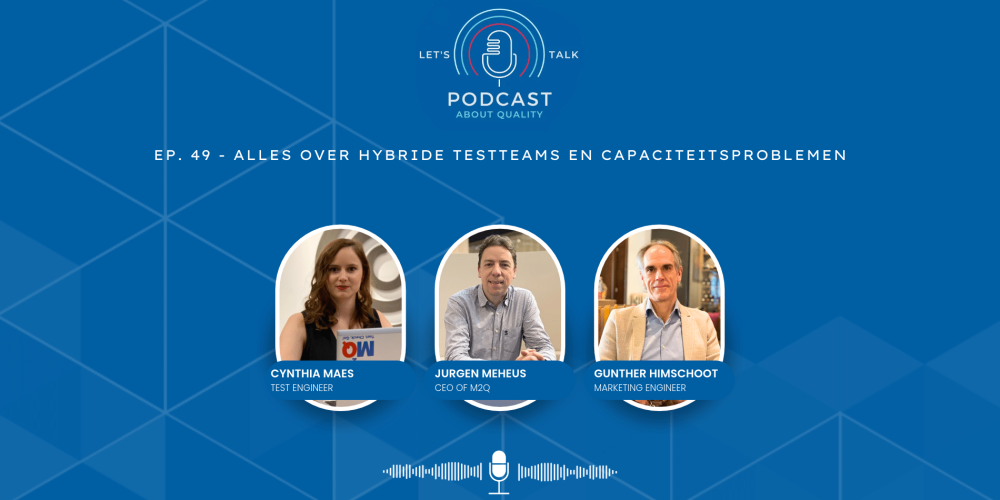
In a recent episode of M2Q’s The Quality Podcast, Jurgen Meheus and Gunther Himschoot take a closer look at a smart strategic solution: hybrid testing teams.
In this in-depth article, you’ll discover exactly what a hybrid test team is, how flexible scaling (ramp-up and ramp-down) works in practice, what role documentation and test strategy play, and how your organization can start building a future-proof quality policy today.
When we talk about a hybrid testing team, we are not referring to a combination of working from home and working in the office. In the context of Quality Assurance and software testing, a hybrid team refers to the synergy between an organization’s internal employees and external QA specialists from a dedicated partner such as M2Q.
In many traditional enterprise systems, software testing is not a full-time, dedicated role. Often, testing tasks are “taken on as a side job” by a business analyst, a functional administrator, or a software developer. Although these internal staff members have a tremendous advantage—namely, in-depth knowledge of business processes and the IT landscape—they often lack the specific core expertise required for structured software testing.
On the other hand, there are external QA consultants. They bring specific expertise in methodologies, test automation, performance testing, usability, and security.
A hybrid test team brings these two worlds together into a single, integrated team:
In-house staff: They ensure the functional context, are familiar with the end users’ needs, and understand the business impact of applications.
External QA experts: They bring structure, independence, methodological support, and specialized technical skills to the table.
The shortage of suitable test profiles is a daily reality in the Belgian IT market. Companies want to release software faster, but high-quality testing often falls by the wayside due to time constraints or a lack of manpower.
There are three key factors at play:
In medium-sized and even large organizations, there isn’t always the budget or the stability to hire full-time, dedicated testers. Testing is done “on the side.”
In so-called User Acceptance Testing (UAT), end users are often called upon to validate new features. However, these people already have their hands full with their daily operational tasks. Burdening them with additional testing work—without a clear structure or guidance—leads to frustration, delays, and missed bugs.
Specialized roles, such as performance testers or test automation engineers, are scarce and costly to keep on the payroll permanently if you only need their specific expertise for a few months a year.
Setting up a hybrid testing team offers solutions to these challenges. In the podcast, Jurgen Meheus and Gunther Himpschoot highlight four key benefits:
One of the greatest strengths of external testers is their independence. They are not bound by internal corporate culture, silos, or the well-known “corporate blindness.” Someone who has been working with the same software for ten or twenty years takes certain quirks of a system for granted. An external QA consultant comes in with an open mind, asks critical questions, and uncovers pitfalls that have become invisible to others.
Software development rarely follows a straight, flat line. It often follows a wave-like pattern (a sine wave): periods of calm preparation alternate with intense peaks just before a major release or go-live.
With a hybrid team, you can scale up and down extremely flexibly using a ramp-up and ramp-down model:
Ramp-up: When the deadline is approaching and hundreds of test scenarios need to be executed—either manually or through automation—in a short period of time, you temporarily expand the team with additional external staff or specialized experts (e.g., a performance tester).
Ramp-down: After a successful production release, things return to normal. The external support is phased out, ensuring your organization isn’t left with unnecessary overhead costs.
Not every project requires a full-time, highly skilled test automation architect or security tester. In a hybrid model, you bring in specific niche expertise exactly when you need it. Do you need to run a load test on the application for 10,000 concurrent users? Then you add a performance testing expert to your hybrid team for that specific phase.
By having external QA consultants collaborate with internal staff, a natural transfer of knowledge takes place. Internal staff learn how to design and execute test cases in a structured manner, which permanently strengthens the overall culture of quality within the organization.
Every coin has two sides. Working with a hybrid team structure also presents specific management challenges. How do you ensure that a changing team composition doesn’t lead to a loss of knowledge or inefficiency?
When external staff leave the project after a busy testing phase, there is a risk that the knowledge they’ve built up will be lost. If there’s another peak two months later, you don’t want new (or returning) testers to have to start from scratch.
M2Q’s solution:
Documentation-Based Assurance: Ensure that test scenarios, test data management, and system structures are documented clearly and concisely.
Flexible continuity (rolling presence): M2Q often recommends keeping a central QA Lead or Test Manager on standby in the background (for example, one day or half a day per week). This person ensures consistency and oversees the test strategy. As soon as a new peak occurs, capacity can be scaled up immediately based on those existing foundations.
In many Agile and Scrum environments, there is a misconception that nothing needs to be documented. People often cite the value “Working software over comprehensive documentation. “
Nevertheless, minimal, structured documentation is essential. Since hybrid work and remote work have become the norm, teams can no longer rely solely on verbal handoffs in the so-called “war room.” Well-defined test cases and clear acceptance criteria (user stories) ensure that external testers can get to work effectively right away, which drastically reduces onboarding time and costs.
A frequently asked question is: Which roles should you ideally fill internally, and which ones are better suited for external hires?
There is no “one-size-fits-all” answer, but the breakdown below provides a proven foundation:
| Role on the test team | Preference / Responsibilities | Why? |
| QA Manager / Test Lead | In-house or long-term contract | Oversees the overall quality strategy, reports to stakeholders, and ensures continuity across multiple releases. |
| Business / UAT Tester | In-house | Possesses in-depth domain knowledge of business processes and end-user requirements. |
| Test Engineer (Manual) | Hybrid (in-office + remote ramp-up) | Executing test scenarios during peak periods to relieve the internal organization. |
| Test Automation Engineer | Contract (Specialist) | Setting up reusable low-code or automated test frameworks requires specific technical QA knowledge. |
| Performance / Security Specialist | Contract (project-based) | Niche expertise that is often needed only during specific testing phases. |
As Jurgen Meheus notes in the podcast: “Ultimately, there should be no perceptible difference in quality between an internal and an external employee on the job. You work together as a single, close-knit team toward the same ultimate goal: delivering a high-quality, reliable software product.”
Does your organization want to make the transition to an agile and efficient hybrid testing model? Then follow this practical roadmap:
First, take a look at what you already have in-house. Which internal employees show an interest in quality and software testing? Perhaps there are people on the team who are open to a career change or retraining in QA.
Note: Never force employees to take on testing tasks if they lack intrinsic motivation. Software testing is a specialized field that requires precision, curiosity, and patience.
Regardless of the team composition, we must ask ourselves: What exactly do we want to achieve in terms of quality?
Is the goal to reduce critical bugs in production?
Do you want to shorten release cycles through automation?
Do you want to reduce the pressure on business departments?
Analyze the release roadmap for the coming year. Where do you expect peaks in workload? At what times will you need additional staff or specific technical expertise?
Pair junior or in-house testers with experienced external consultants. An on-the-job coaching program accelerates the learning process and ensures that best practices are immediately applied within your own projects.
Building an optimal testing team doesn’t have to be a complex or unaffordable process. It’s all about finding the right balance between internal domain knowledge and external technical expertise.
At M2Q, we believe in partnerships that truly help organizations move forward. Our philosophy isn’t about making a client dependent on external consultants, but rather about enabling your organization to operate independently and with a focus on quality in the long run.
Do you have doubts about your company’s current approach to software testing? Are you unsure about what roles you need or where the bottlenecks are?
Through a no-obligation mini-assessment or mini-audit, M2Q’s experts will visit your location:
We analyze your current testing processes, tools, and quality objectives.
We clearly identify areas for improvement and quick wins.
We develop a feasible roadmap for the short, medium, and long term.
👉 Request your mini-assessment here on M2Q.be
Would you like to listen to the full conversation between Jurgen Meheus and Gunther Himpschoot? Listen to this and other episodes of The Quality Podcast on Spotify, Apple Podcasts, or Google Podcasts, or visit our podcast page at m2q.be/podcast.