
Practical insights from M2Q’s testing experts
In our latest podcast episode, we compare two concepts that are often confused in practice: acceptance testing and beta testing. Because although they both take place at the end of a testing process, they are fundamentally different exercises, with different objectives, different audiences, and different outcomes.
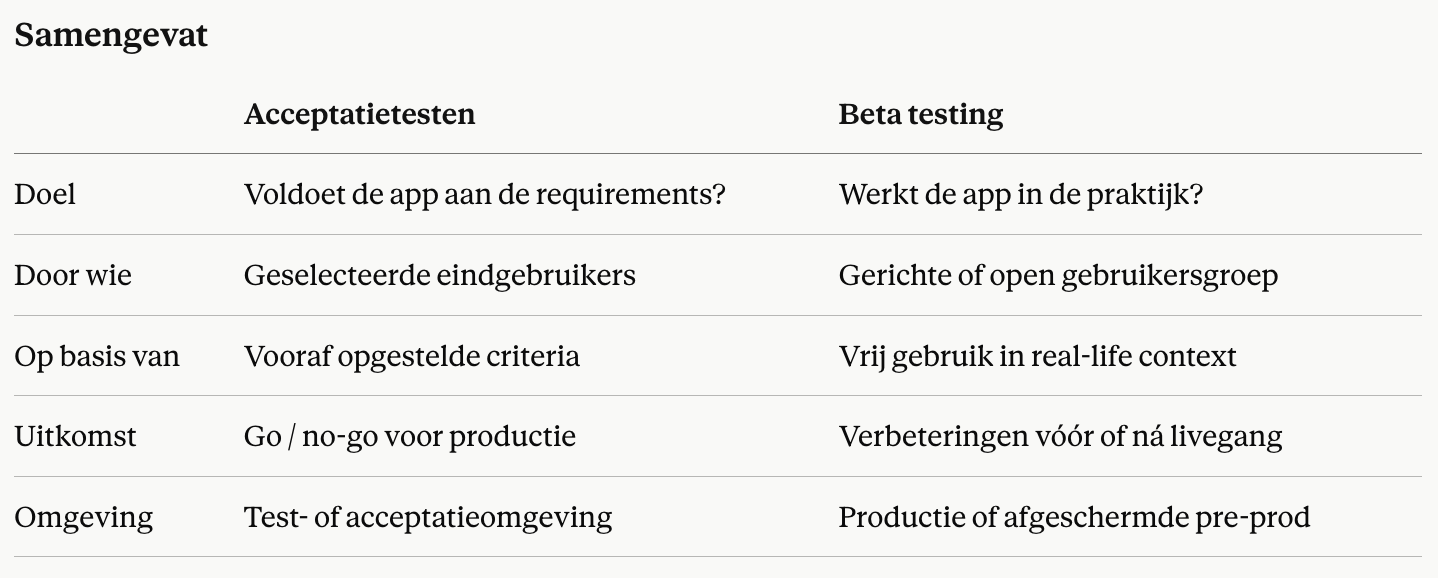
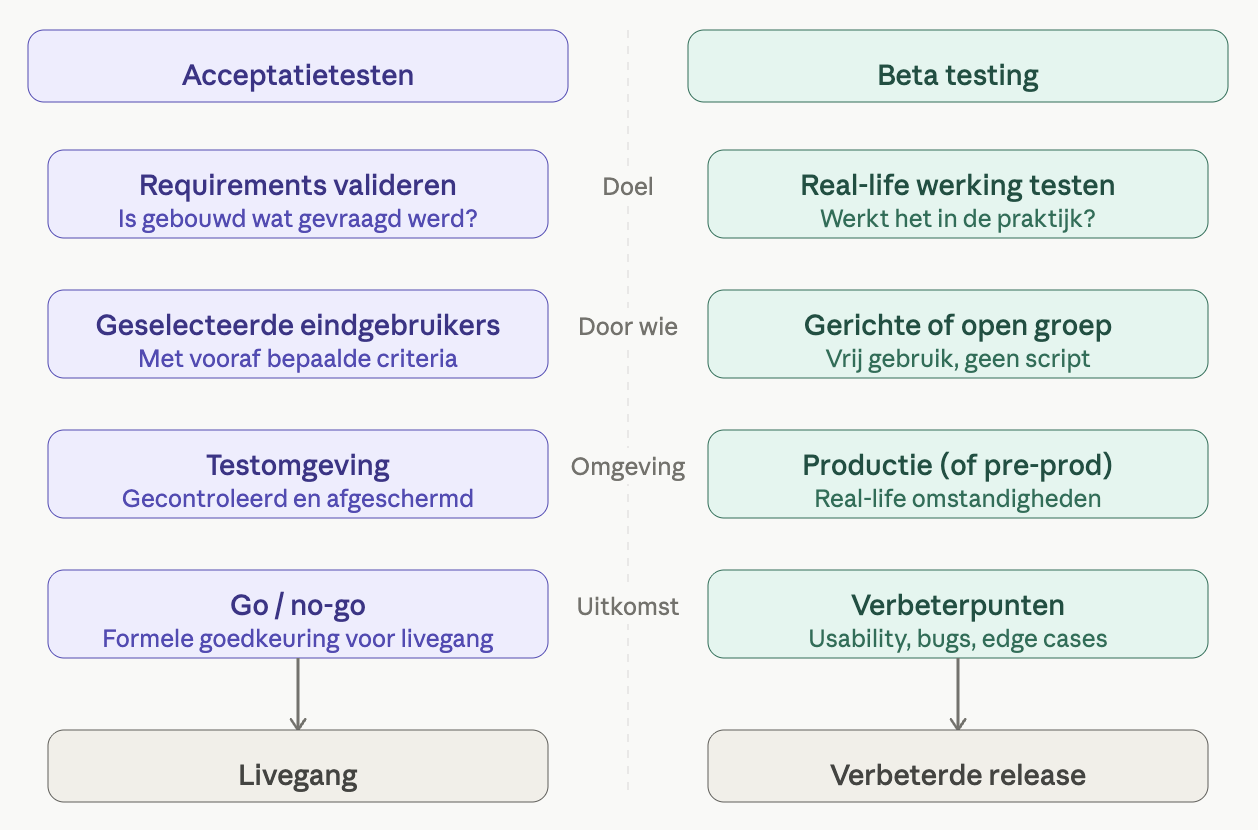
Acceptance testing (or UAT, User Acceptance Testing) is based on predefined acceptance criteria. End users verify whether the application meets the business requirements that were defined at the start of the project. It is a formal check: has what was agreed upon been delivered?
Beta testing works differently. The application is already up and running—either in production or in a protected environment—and a group of users puts it through its paces in a real-world setting. No checklist, no script. The goal isn’t to verify whether requirements have been implemented, but to discover how the software behaves in the real world.
“Acceptance testing checks whether the requirement has been implemented. Beta testing checks whether the application works in practice. That difference may be greater than you think.”
A concrete real-world example illustrates that difference perfectly. During a project for a port management system, boats, registrations, and traffic flows were managed through an application that had to be usable both onshore and at sea.
Functional tests: passed. Acceptance tests with end users: completed successfully. And yet, it wasn’t until the beta test—conducted from an RWS boat in the harbor channel—that it became apparent that certain remote corners of the harbor were outside the Wi-Fi range. The connection dropped, and the application faltered. Not something you’d discover in a controlled test environment.
That is precisely the value of beta testing: uncovering problems that only arise in real-world conditions.
Beta testing can be organized in two ways:
On the one hand, there’s the open approach, in which a broad group of users is free to experiment with the application. Think of a “beta” button in an existing tool that lets anyone try out new features. The feedback is broad, and the impact is harder to control.
On the other hand, there is the targeted approach, in which specific target groups are selected based on usage, region, or profile. This provides more structured feedback and allows for the evaluation of targeted scenarios. For an app designed for healthcare staff that tracks home visits, you should ideally select those employees and let them go about their daily work using the new tool.
During a project for Audi, back when electric cars were still a true innovation, an app was developed to track driving behavior and convince potential buyers of the feasibility of electric driving. UAT: passed. But once the app went live with real test drivers, it turned out that the constant satellite connection put a significant strain on the cell phone battery. A dead battery halfway through the day wasn’t a hypothetical risk, but a real problem.
You don’t gain insights like that from a test environment. You gain them from real-world experience.
A frequently asked question: How do you know what’s going wrong if there’s no analyst watching? In most cases, through a built-in bug reporting feature—a simple button that allows users to report errors directly to the development team. Alternatives include a structured checklist or a feedback portal where testers log their findings.
Apple even provides a separate platform for this: TestFlight, which allows beta versions of apps to be rolled out to a select group of testers before the official launch on the App Store.
The test manager or QA manager determines, in consultation with the client, which test levels will be used and whether beta testing is part of the process. That decision depends on the type of application, its intended use, and the desired quality standard at launch.
For some organizations, beta testing is a standard step in every project. For others, it’s a deliberate choice based on their risk profile. In both cases, a well-thought-out testing strategy prevents costly surprises after going live.