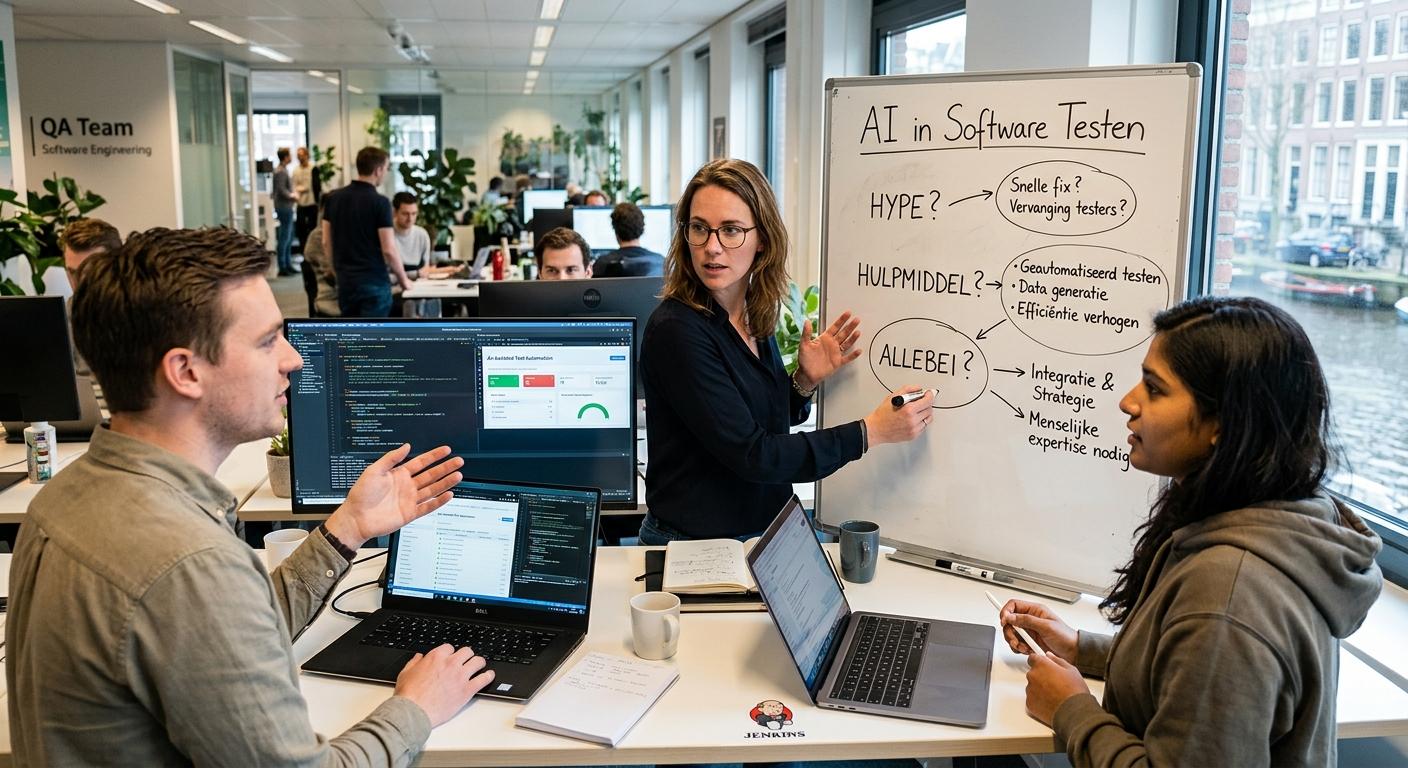
Artificial intelligence (AI) has long since ceased to be a pipe dream. What once began as an academic experiment is today an indispensable technology transforming industries, and software testing is no exception. In the latest episode of the M2Q Quality Podcast, Jackie Janssen, AI Strategy Consultant, and Jürgen Meheus, Managing Partner at M2Q, delved into what AI means for software quality, where the opportunities lie, as well as what pitfalls to avoid.
In this blog post, we bring together the insights from the conversation into a clear and practical overview of how AI in software testing is reshaping the industry.
What is AI really?
According to Jackie Jansen, AI is essentially an advanced form of statistics: systems that recognize patterns on a large scale, make predictions and make decisions based on data. “AI is not a magic brain,” he stresses. “It’s math and computational power, but applied in ways that exceed human capacity.”
Yet the accessibility of AI has increased dramatically in recent years, with ChatGPT’s November 30, 2022 launch date as the tipping point. Whereas AI used to be reserved for specialized companies, today it is embedded in the daily work of testers, developers and even end users.
The concrete impact of AI on software testing
-
Automation of test generation
One of the most tangible applications of AI in software testing is the automatic generation of test cases. Previously, testers had to write these out manually based on requirements. Today, AI can automatically create scenarios based on a simple user story or description. This provides:
-
- Accelerated test preparation
- Less human error
- Faster feedback loops in agile development environments
As Jurgen explains, “You enter an analysis as a tester, and your test management tool automatically generates the positive test cases based on that. The negative cases soon follow as well. That way you work faster and with higher test coverage.”
-
Regression testing and pattern recognition
AI excels at pattern recognition, an essential aspect of regression testing. By analyzing historical data, AI can accurately assess which components are prone to errors and where regression testing should be prioritized. This increases not only the efficiency, but also the reliability of the testing process.
-
Log analysis and user simulations
By analyzing log data, AI learns user behavior and can simulate realistic usage scenarios. As a result, bugs that remain under the radar in traditional testing are detected more quickly. This makes AI particularly suitable for load testing and UX validation.
AI is not a replacement, but a reinforcement
An important consensus from the conversation between Jackie and Jurgen: AI will not simply replace the role of the manual tester, but it will drastically change it. “We are evolving to a shift where human testers will be coordinating, analyzing and checking more than performing themselves,” Jurgen argues.
AI is taking over repetitive tasks, but human nuances, such as sensing UX or assessing business impact, remain crucial. So the tester of the future will be more of an AI-assisted test strategist than a traditional test executor.
Privacy, bias and ethics: the side notes on AI
AI brings not only benefits but also new responsibilities. Bias and erroneous output are real risks if models are trained on colored or incomplete data. Sharing sensitive information with public AI models (such as ChatGPT) can also inadvertently expose corporate data.
Therefore, there is growing demand for private AI solutions, on-premise models, which are trained on in-house data without external sharing. Jurgen expects this to become the standard in Europe, partly due to stricter regulations such as the AI Act.
An additional advantage of private AI is the ability to train the model on specific domain knowledge, which improves accuracy and reliability.
AI testing? Yes indeed!
A striking but important insight: AI itself must also be tested. The output of AI models must be validated for correctness, completeness, relevance and bias. That means software testers must also learn to deal with:
Validation of AI models
Interpretation of model decisions
Auditing output on an ethical and legal basis
New protocols such as MCP (Model Check Protocol) provide support for testing AI systems.
AI is changing the entire software lifecycle
AI is not limited to the testing process. Requirements gathering, development, deployment and monitoring are also affected. Jurgen even envisions a future where we no longer need programming languages: “If you can talk to a computer and it does what you ask, why write code?”
For now, this mainly means that the turnaround time of software projects is drastically reduced, and that companies can achieve greater results with a smaller IT team, provided they deploy the right AI tools.
AI as a catalyst for test automation
Test automation had hype before, but the big difference with AI is the speed of adoption and maturity of the tools. AI makes automation accessible to a wider audience. Tools like GitHub Copilot, Azure AI or open-source LLMs like Meta’s LLaMA offer powerful capabilities for automated test code generation, data analysis and test execution.
The combination of AI and test automation provides:
- Lower costs
- Higher speed
- Better coverage
- Less human error
What is the future of AI in software testing?
AI will not replace everything, but it will change everything. Testing strategy, the role palette, tooling and even infrastructure will have to change. Companies that start experimenting today are building a head start. That head start translates into faster release cycles, higher customer satisfaction and lower incident rates.
What is certain: the human tester remains relevant, but in a new role as quality director, data-driven decision maker and AI supervisor.
AI in Low Code Test Automation Tools: smart accelerators for test teams
In addition to traditional test automation, we are seeing a strong emergence of low-code test automation tools such as Tricentis Tosca, Katalon Studio and SmartBear TestComplete. These platforms combine user-friendly interfaces with powerful AI support. This allows non-technical profiles to create, maintain and optimize test scenarios-without in-depth programming knowledge.
AI plays a key role in this by:
- Generate smart test proposals based on user stories or requirements
- Automatically recognize and update fluctuating UI elements
- Manage test data dynamically with built-in intelligence
AI allows low-code platforms to adapt test cases faster to evolving applications, leading to shorter release cycles and reduced maintenance costs. Especially in agile and DevOps contexts, these tools are a valuable lever for test teams.
Key takeaways
- AI in software testing accelerates and improves testing processes through automation, pattern recognition and data-driven decision making.
- The role of the tester is changing: from implementer to controller and strategist.
- Privacy, bias and ethics require attention, especially with public AI tools.
- Private and on-premise AI are becoming increasingly important in Europe.
- AI itself must also be tested: validation of models is essential.
- The future is hybrid: human intelligence enhanced by artificial intelligence.
Are you ready for the AI transformation?
AI is not a temporary hype, but a structural change within software quality. For organizations, this means anticipation, experimentation and, above all, learning. M2Q closely follows this evolution and guides companies in their transformation to AI-integrated testing strategies.
Want to discover how your organization can benefit from AI in software testing? Contact our experts at info@m2q.be and join us in stepping into the future of QA.